If you’re interested in contributing a short What Am I Reading post, we’d love to hear from you! Email us at cache@colorado.edu
Written by Jenna Tipaldo, CUNY School of Public Health and CUNY Institute for Demographic Research, jenna.tipaldo09@sphmail.cuny.edu
A new report from Winkler & Mockrin (2025) entitled “Aging and wildfire risk to communities” explores the exposure of older populations to wildfires. A main findings is that “Nearly all (87 percent) of the population growth in higher wildfire risk locations between 2010 and 2020 was among people over the age of 60, many of whom had been living in higher risk places for years and are growing older (i.e., aging in place).” Each is relevant when thinking about older adults and exposure, vulnerability, and resilience to disasters. Wildfires are just one of type of disaster to consider: recent evidence also suggests that coastal zones – areas at risk of storms and other seaward hazards such as flooding and tsunamis – are also aging faster than areas farther inland (Bukvic et al., 2018; Hauer et al., 2020; Tagtachian and Balk, 2023).
No relocation: Forsyth & Molinsky (2020) note that to some, aging in place signifies remaining in their home while to others it may mean moving but within the same community, such as downsizing. Based on recent shifts in age distribution in Census blocks with “moderate-to-high” wildfire risk, Winkler & Mockrin (2025) conclude that the increase in older adult populations in fire-prone regions is likely attributable to populations aging in place rather than in-migration (Figure 4). They also note important spatial variation and also uncertainty about the relative contributions of migration and death. They also note that aging in place seems to be the “primary mechanism” in higher risk rural areas (Winkler & Mockrin, 2025).
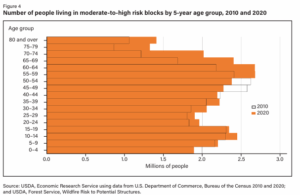
Source: Winkler & Mockrin (2025)
Health and Health Care : Winkler & Mockrin (2025) summarize the various ways in which older adults can be at higher risk due to wildfires including 1) physical limitations that are barriers to preparation or response, 2) factors like social isolation which can impact access to information and resources, and 3) higher rates of chronic diseases which are risk factors for adverse health outcomes due to fires and smoke. Furthermore, disasters can be disruptive to healthcare, not only by damaging facilities and displacing people from their homes but also by disrupting care which relies on movement. Examples include when patients are unable to travel to hospitals or medical providers, or if healthcare workers can‘t get to a patient’s home due to inaccessible roads (Tarabochia‐Gast et al., 2022) or suspended public transit systems. Rural areas face additional challenges with longer travel times for healthcare access, especially with high levels of hospital closures (Miler et al., 2020; McCarthy et al., 2021). Such patterns negatively impact health care access, emergency medical response, and transport times (GAO, 2021; Kaufman et al., 2016). On average, rural residents must travel about 20 miles farther for typical health care services – in non-disaster times (GAO 2021). While those miles may seem trivial, in emergencies they can mean loss of access to care and treatment.
Personal choice: Aging in place can be a personal choice in support of maintaining one’s agency and independence by staying in one’s own home and community (Forsyth & Molinsky, 2020). Even so, staying in one’s home can also result from lack of choice due to limited resources and/or few desirable and affordable options. Modifications are expensive too. Even older adults who are relatively better off can struggle to pay for downsizing or modifying a new dwelling for care needs (Forsyth & Molinsky, 2020).
From research to policy
To help support healthy aging in place, Winkler & Mockrin (2025) suggest that existing programs that support older adults could be expanded to include wildfire risk reduction. An example is the USDA’s Section 504 Home Repair program which supports older low-income homeowners. In addition, organizations such as the AARP provide useful material for aging in place such as a checklist for people who are prepping their home. Such resources should be expanded to include disaster risk as a consideration.
References:
- Bukvic, A., Gohlke, J., Borate, A., and Suggs, J. 2018. “Aging in Flood-Prone Coastal Areas: Discerning the Health and Well-Being Risk for Older Residents.” International Journal of Environmental Research and Public Health 15(12):2900. https://doi.org/10.3390/ijerph15122900.
- Hauer, Mathew E., Elizabeth Fussell, Valerie Mueller, Maxine Burkett, Maia Call, Kali Abel, Robert McLeman, and David Wrathall. 2020. “Sea-Level Rise and Human Migration.” Nature Reviews Earth & Environment 1(1):28–39. https://doi.org/10.1038/s43017-019-0002-9.
- Forsyth, A., & Molinsky, J. (2020). What Is Aging in Place? Confusions and Contradictions. Housing Policy Debate, 31(2), 181–196. https://doi.org/10.1080/10511482.2020.1793795
- GAO (General A. Rural Hospital Closures: Affected Residents Had Reduced Access to Health Care Services. GAO-21-93. Published online 2021. https://www.gao.gov/products/gao-21-93
- Kaufman, B.G., Thomas, S.R., Randolph, R.K., et al. The rising rate of rural hospital closures. The Journal of Rural Health. 2016;32(1):35-43. https://doi.org/10.1111/jrh.12128
- McCarthy, S., Moore, D., Smedley, W. A., Crowley, B. M., Stephens, S. W., Griffin, R. L., Tanner, L. C., & Jansen, J. O. (2021). Impact of Rural Hospital Closures on Health-Care Access. Journal of Surgical Research, 258, 170–178. https://doi.org/10.1016/j.jss.2020.08.055
- Miller, K.E.M., James, H.J., Holmes, G.M., Van Houtven, C.H. The effect of rural hospital closures on emergency medical service response and transport times. Health Serv Res. 2020;55(2):288-300. https://doi.org/10.1111/1475-6773.13254
- Tagtachian, D. and Balk, D., 2023. Uneven vulnerability: characterizing population composition and change in the low elevation coastal zone in the United States with a climate justice lens, 1990–2020. Frontiers in Environmental Science, 11, p.1111856.
- Tarabochia‐Gast, A. T., Michanowicz, D. R., & Bernstein, A. S. (2022). Flood Risk to Hospitals on the United States Atlantic and Gulf Coasts From Hurricanes and Sea Level Rise. GeoHealth, 6(10), e2022GH000651. https://doi.org/10.1029/2022GH000651
- Winkler, R. L., & Mockrin, M. H. (2025). Aging and wildfire risk to communities (Report No. EIB-284). U.S. Department of Agriculture, Economic Research Service. https://doi.org/10.32747/2025.9015828.ers