If you’re interested in contributing a short What Am I Reading post, we’d love to hear from you! Email us at cache@colorado.edu
Written by Kathryn Foster, Cornell University and Alex Mikulas, PhD, University of Colorado-Boulder
Increasing drought and an aging population
Numerous studies find strong associations between the occurrence of drought and adverse health effects, including increased mortality (Abadi et al., 2022; Sekhri et al., 2014), depression (Vins et., 2015), lower birth weights (Diamond-Smith et al., 2023), and suffering from vector-borne diseases (Salvador et al., 2023). However, older adults have received little attention on drought-related health, with much of this research examining health in early-life (babies, children) including the potential health effects of exposure to drought when mothers are pregnant (“in utero”).
As such, there is a significant gap in understanding how drought’s slow-onset environmental hazard might affect the health of older adults, a key population growing globally. Another problem is that our understanding of the specific ways in which drought affects health remains limited. This is in part because it is very difficult to identify and measure drought exposure. Some studies have tried to address both challenges by integrating drought and longitudinal health data (Abadi et al., 2022), yet non-standard and obtuse drought measures complicate any assessment of the mechanisms by which drought affects health in later life.
To address inconsistent drought index selection and a lack of health-specific definitions, Berman and colleagues (2024) propose a health drought research framework. They urge researchers to identify exposed and vulnerable populations, link metrics directly to specific health outcomes (e.g., mental distress, respiratory illness, water or food insecurity), characterize drought through multiple measures, and consider compounding hazards. In addition, Tipaldo and colleagues (2024) provide an overview of how demographic aging intersects with climate hazards, synthesizing the ways in which older adults face disproportionate risks. They argue that climate-health research for older adults should consider how environmental, social, and biological factors influence health in older populations. They emphasize the need for studies that examine cumulative impacts and climate change factors across the life course, reinforcing Berman et al.’s recommendation to evaluate multi-month or multi-year drought exposures. Together, these approaches guide researchers to specify the target disease, characterize the drought by severity, spatial extent, and duration, and map co-occurring hazards to construct appropriate health-drought indices (Berman et al, 2024; see figure 1).
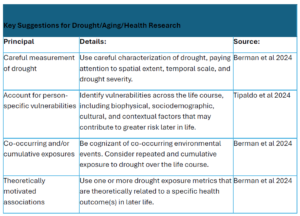
Different measures, consistent patterns
In a recent study, Dr. Joseph Saenz and colleagues (2026) enacted these suggestions by examining how different measures of drought exposure affect multiple cognitive function outcomes in Mexican older adults. They used data from the Mexican Health and Aging Study (MHAS), a nationally representative longitudinal survey of adults 50 and older (and a sister study to the US Health and Retirement Study, HRS). The authors linked individual-level data on cognitive function from 2003 (pre-drought) and 2012 (post-drought) to municipality-level drought severity records from the Mexican Drought Monitor. The study focuses on Mexico’s severe 2010–2012 droughts, which affected over 80% of the country and lasted more than a year in some regions. Given that prolonged droughts increased stress, depression, and food insecurity (Berman et al., 2024), Saenz and colleagues hypothesized that varying drought durations and severities would also cause cognitive dysfunction through similar pathways.
Rather than relying on a single definition of “exposure,” the authors constructed separate measures that captured both the total months of drought experienced during the study period and the longest consecutive streak of drought. These were further stratified with two severity thresholds, creating four separate measures of drought exposure. Drought measures are captured at the municipality level and linked to participants based on their location of residence. The drought measures are:
- the total number of months a participant experienced any drought,
- the total number of months a participant experienced severe drought,
- the longest streak of consecutive months a participant experienced any drought,
- the longest streak of consecutive months a participant experienced severe drought.
Using this data and exposure schema, the authors evaluated how drought exposure relates to verbal learning, verbal recall, visual scanning, and verbal fluency. They adjusted for pre-drought cognitive scores, mental health, nutrition, and a range of demographic and socioeconomic factors.
Saenz and colleagues (2026) found that longer drought exposure was consistently linked to worse performance on verbal learning and verbal recall, tasks that draw on memory, regardless of which of the four drought measures were used. Visual scanning, a task more tied to attention, showed no meaningful association with drought at all. Verbal fluency told a more complicated story: the relationship was non-linear, with the best performance among those exposed to roughly six to eleven months of drought, and worse performance among those with either very short or very long exposure. The mechanisms connecting drought to memory specifically, rather than attention, are still speculative. But notably, none of these associations were explained by pathways most proposed in the literature, such as mental health, stress, or nutritional covariates, which the authors considered in their analyses.
Future of Drought-Age Research
In their study, Saenz and colleagues (2026) connect disparate bodies of research on drought and on cognition to articulate the empirical and theoretical reasons that we might expect an association between drought and downstream cognitive decline. In drought literature, they note that economic security, nutrition, and mental health are all impacted by drought. And in a separate literature on later-age cognitive decline, similar measures of economic security, nutrition, and mental health are all known to directly impact cognitive decline. But still, the drought-health conversation has largely neglected any attempt to describe the association between drought and specific measures of age-related cognition.
Saenz and colleagues’ (2026) study offers a useful template of what future research on the environment’s role in age-related health might look like, and specifically why exploring associations between drought and multiple cognitive outcomes is important. First, by showing that drought-related cognitive effects appear concentrated in memory rather than attention, for instance, the study offers a useful clue for future research: not all cognitive domains may be equally vulnerable to environmental stressors like drought. The authors note that effects of drought on different cognitive domains may follow similar patterns to those already suggested by research on heat waves.
Secondly, existing studies lacked a standardized way of defining “drought exposure,” a problem that complicates comparison across studies and makes it hard to know whether inconsistent findings reflect real differences or simply differences in measurement. It may be that many different types of drought measures may be needed to continue detangling the ways drought can impact older adult health. That said, the largely consistent pattern of results across multiple drought exposure and cognitive outcome measures provides a more convincing form of evidence than results from studies examining single-measured associations.
This work sits at the intersection of two global trends that will only increase as this century unfolds: population aging and worsening extreme events and weather-related disasters. By establishing that the association between drought and age-related cognition exists along some dimensions and not others, this study makes evident a greater need for research that examines the role of drought for health in the growing and increasingly vulnerable aging population. This is especially so because slow-onset hazards like drought have the ability to impact more people, and over a longer period of time. The authors conclude by noting that drought response is typically reactive, providing relief during and after a drought rather than anticipating its slower-moving health consequences. Their findings offer a case for proactive community-level resilience and drought preparedness efforts particularly for older residents who may be least equipped to manage prolonged environmental stress.
Importantly, the HRS and its sister studies make it possible to examine mid-life and multiple exposures as people age. This requires use of such data in the various restricted-access enclaves that allow for use of individual life-histories, including residential locations, and data that allows for some explanation of mechanisms that might mediate the relationship between environmental exposure and later life-outcomes. As more research uses longitudinal datasets with environmental data, it will become clearer where improvements in that data infrastructure are needed to answer these emergent questions.
References
- Abadi, A. M., Gwon, Y., Gribble, M. O., Berman, J. D., Bilotta, R., Hobbins, M., & Bell, J. E. (2022). Drought and all-cause mortality in Nebraska from 1980 to 2014: Time-series analyses by age, sex, race, urbanicity and drought severity. Science of the Total Environment, 840, 156660.
- Berman, J. D., Abadi, A. M., & Bell, J. E. (2024). Existing challenges and opportunities for advancing drought and health research. Current Environmental Health Reports, 11(2), 255-265.
- Diamond-Smith, N. G., Epstein, A., Zlatnik, M. G., & Treleaven, E. (2023). The association between timing in pregnancy of drought and excess rainfall, infant sex, and birthweight: Evidence from Nepal. Environmental Epidemiology, 7(5), e263.
- Salvador, C., Nieto, R., Vicente-Serrano, S. M., García-Herrera, R., Gimeno, L., & Vicedo-Cabrera, A. M. (2023). Public health implications of drought in a climate change context: a critical review. Annual Review of Public Health, 44(1), 213-232.
- Saenz, J., Aguila, E., Tanner, L., Downer, B., Peniche, J., & Wong, R. (2026). Drought and cognitive function in older adults: results from the Mexican health and aging study. Environment international, 110053.
- Sekhri, S., & Storeygard, A. (2014). Dowry deaths: Response to weather variability in India. Journal of development economics, 111, 212-223.
- Tipaldo, J. F., Balk, D., & Hunter, L. M. (2024). A framework for ageing and health vulnerabilities in a changing climate. Nature Climate Change, 14(11), 1125-1135.
- Vins, H., Bell, J., Saha, S., & Hess, J. J. (2015). The mental health outcomes of drought: a systematic review and causal process diagram. International journal of environmental research and public health, 12(10), 13251-13275.