
What Am I Reading? Evaluating How Extreme Weather Events Can Affect Health Care Utilization

What Am I Reading? Evaluating How Extreme Weather Events Can Affect Health Care Utilization

If you’re interested in contributing a short What Am I Reading post, we’d love to hear from you! Email us at cache@colorado.edu


Written by Sara Curran and June Yang, University of Washington

Research on disasters and health has increasingly leveraged linked administrative claims data and detailed spatial information on natural disaster events in order to move beyond single-case descriptions toward quasi-experimental designs. Such linkages aim to improve knowledge about the proximate mechanism (such as health care utilization) that link the consequence of disasters to health outcomes.  Such insights about the mechanisms can then help target improvements for resilience and adaptation in the future. For example, a recent study of Puerto Rico integrated private insurance claims and beneficiary counts from multiple insurers to construct harmonized region–year indicators of infectious disease, injury, and mental health service use, and then interpreted abrupt shifts in these indicators around hurricanes, earthquakes, and the COVID-19 pandemic as signatures of disaster-related disruption to health care access and need (Stimpson et al., 2025).  Building on the same logic of combining high-resolution utilization data with externally defined measures of hazard exposure and loss, another study links national Medicare fee-for-service claims with standardized disaster databases to estimate the short-term effects of extreme weather events on morbidity and mortality across U.S. counties (Salas et al., 2024).  We summarize each article here and then offer a few suggestions for future research.

Stimpson et al. (2025) innovatively developed a harmonized repeated, cross-sectional insurance claims dataset from 2016-2022 in Puerto Rico. The aggregated data included information from each region and year about injuries, infectious diseases, mental health, and substance use claims and was standardized by the number of beneficiaries per region and year.  The annual trend lines for each type of claims category are descriptively evaluated for each region.  Following Hurricane Maria, they find in the affected regions larger or higher increases in claims related to infectious disease, injury, mental health, and substance use.  Regions that were less impacted by Hurricane Maria showed lower rates of claims across all types.  The authors argue that the data point to the need for targeted interventions to enhance overall infrastructure, especially health care infrastructure for improved health outcomes.  The Stimson et al. study is a good example of creatively generating valuable evidence from insurance claims data to descriptively observe trends and patterns. The limitations of the study’s results are in the relatively small number of cases (region-year), making it impossible to statistically evaluate whether the differences are significant.   

With a similar motivation for attention to study design, a recent article by Renee Salas and colleagues published in Nature Medicine creatively links NOAA and SHELDUS (Spatial Hazards and Economic Loss Data in the US) to Medicare fee-for-services administrative data to evaluate the impact of extreme weather events on health outcomes. The study examines counties impacted by at least one of 42 NOAA-identified, extremely damaging events (damages a total value of US$ 1 billion or higher), occurring between 2011 and 2016, and seeks to understand whether health outcomes changed in unaffected and affected counties before and after the event.  They use the SHELDUS data to identify county-level damages for affected counties (the property and crop damages for those affected counties ranges between $3,220-$12.51 billion per county).  Combined with the CMS data at the county-level they systematically compare affected and non-affected counties.  This valuable quasi-experimental design offers a careful comparison across time evaluating impacts the week following a disaster, 1-2 weeks after, and 3-6 weeks after. These spatial and temporal comparisons across the entire country, offer an important national assessment of the immediate and lagged health outcome effects of severe weather events.  Notably, the study limits itself to floods, severe storms, and winter storms, which, they argue, are events that are relatively short-lived, destroy infrastructure, and can have lingering social and built environment effects.  They contrast these events to wildfire and droughts which often last for hundreds of days and have somewhat different impacts on infrastructure, so the authors do not evaluate these types of events and also exclude counties experiencing them from eligibility in the selection of matched control counties. They make two sets of comparisons.  First, they compare the relative change in health outcomes in affected counties before and after events.  Second, they compare similar counties with and without exposure to the event using a difference-in-difference estimation.  They find similar results with both types of comparisons.

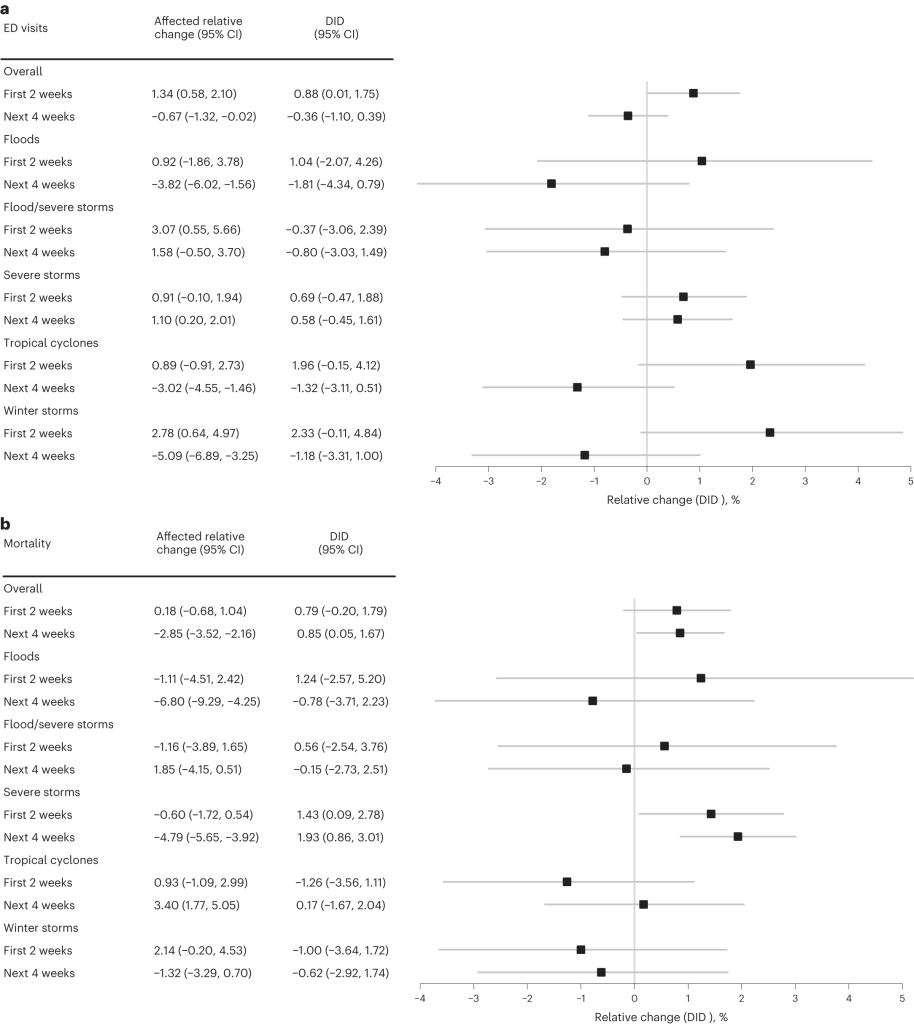
Fig. 2: Forest plots of ED visit and mortality relative change and DID for affected counties in post-disaster weeks 1–2 and weeks 3–6 in Medicare beneficiaries exposed to a short-term NOAA NCEI billion-dollar weather disaster in the United States. (Salas et al., 2024)
Winter storms and tropical cyclones are most damaging to health outcomes 

Their most important findings are summarized in their Figure 2.  They show how emergency department visits and mortality are significantly increased by severe events.  In Panel a. emergency department visits are significantly higher in the first two weeks following a severe event, but not so in the weeks 4 or more.  Most of these differences are driven by severe winter storms and tropical cyclones. In Panel b. mortality is significantly higher across all time lags.  This mortality effect is primarily driven by severe storm events.  Not shown in Figure 2, but discussed elsewhere, is the finding that non-elective hospitalizations remained unchanged over all types of severe storms and all the time lags.  Besides demonstrating how particular types of severe events cause significant increases in emergency department visits and mortality, they also show that among storms totaling more than 1 US $ Billion in damages overall, the most expensive storm events are the ones driving the results (those in the upper quartile of counties (damages ranging between $622.66K-12.51B)).

This analyses and the linked data, together with Stimpson et al. (2025) study, suggest many useful avenues for further research that could leverage routinely collected administrative and claims data to understand the more precise and proximate mechanisms of health care utilization and costs of disasters on the US economy and health, and well-being of the US population. Future work can build on these designs to probe the mechanisms that generate vulnerability, such as pre-existing comorbidities, healthcare access barriers, and disruptions to utilities or transportation, and to identify which communities are more, or less resilient in the face of weather shocks.

Both studies reviewed here highlight the importance of understanding crucial heterogeneity of geography and preparedness impacting health care needs and capacities: for example, winter storms may be especially deadly in places like Texas where infrastructure and housing are optimized for heat rather than cold. Such geographic variation almost certainly intersects with social disadvantage, race, income, and other axes of inequality, suggesting that analyses that explicitly consider these overlapping vulnerabilities in relation to hazard exposure, built environment, and structural conditions are a critical next step. By expanding this line of inquiry to additional disaster types and contexts, researchers can generate evidence that not only clarifies patterns of risk, but also informs theory and policy on the social determinants of disaster vulnerability, resilience, and health system performance.

For those interested, code for Salas et al. (2024) is available at GitHub and can be found at https://github.com/Billion-Dollar-Weather-Medicare/ED-Hospitalizations-Mortality/.

Notes about administrative data:

“Administrative data” here means records generated during the routine administration of healthcare and insurance, for example, billing/claims files, enrollment and beneficiary summary files, and facility or provider administrative records. These datasets are not collected for research, but capture large populations and longitudinal events (visits, diagnoses, procedures, dates and place of care), which makes them powerful for measuring changes in utilization, costs, and short-term outcomes after disasters, while also carrying limitations (limited clinical detail, timing/coverage constraints, and privacy/regulatory restrictions).

Salas et al. (2024) used fee-for-service Medicare administrative claims and beneficiary files to measure ED visits, hospitalizations, and mortality after billion-dollar weather disasters (these Medicare files are controlled by Center for Medicare & Medicaid Services and cannot be redistributed by the authors).  Stimpson et al. (2025) analyzed private insurance claims for Puerto Rico obtained through the territory’s Office of the Commissioner of Insurance, illustrating how regulator-level aggregates from insurers can be used to study regional patterns after consecutive disasters.

References 

  • Salas, Renee, Laura Burke, Jessica Phelan, Gregory Wellenius, E. John Orav, & Ashish Jha. 2024. “Impact of Extreme Weather Events on Healthcare Utilization and Mortality in the U.S.” Nature Medicine  https://doi.org/10.1038/s41591-024-02833-x

    • Stimpson, Jim P., Damaris Lopez Mercado, Alexandra C. Rivera-González, Jonathan Purtle, and Alexander N. Ortega. 2025. “A Regional Analysis of Healthcare Utilization Trends during Consecutive Disasters in Puerto Rico Using Private Claims Data.” Scientific Reports 15(1):5249. doi:10.1038/s41598-025-89983-1.
        Continue reading

        Code analyzing population pyramids for counties exposed to Low Elevation Coastal Zones (LECZs) in Puerto Rico

        Code analyzing population pyramids for counties exposed to Low Elevation Coastal Zones (LECZs) in Puerto Rico 

        Link to code (Quarto markdown version)

        Click here

        Link to code (Github Pages Version)

        Click here

        Date: December 2025


        Authors/Creators/ Team Members:  Deborah Balk, Kytt MacManus, Hieu Tran, Camilla Greene, Shemontee Chowdhury, Juan F. Martinez 

        Specific purpose of code: Integration of Python programming with ArcGIS API to access NASA SEDAC Low Elevation Coastal Zone (LECZ) data, IPUMS API to access U.S. Census Decennial Census data of Age and Sex groups at the Block Group and County levels, create interactive maps, find insights about the changes in population pyramid structures, and compare these changes between areas inside and outside of the Low Elevation Coastal Zone (LECZ) in Puerto Rico. 

        General Application: This lesson demonstrates how to link U.S. Census data with the LECZ Merit-DEM dataset to analyze population and housing changes. It explores regional and local trends (at the county and block group levels) to highlight shifts in age groups within and outside of Low Elevation Coastal Zones (LECZ). The accompanying code enables users to explore census data at multiple geographic scales and integrate spatial environmental data to identify cohorts vulnerable to coastal flooding and observe how populations are changing in these areas. 

        How does or could this code allow researchers to assess research questions related  to aging or life course?: This code could be used with the Decennial data to assess any 5-year age groups from under 5 to 85+ years of age and generate population pyramid charts for 2010 and 2020 to assess changes in age groups over time and space. 

        Data sets used: 

        • Population, socioeconomic, or health data: Decennial Census Data on Age/Sex, Occupancy Status (Vacancy), Social Vulnerabilities in Community Resilience Estimates (CRE)
        • Climate, weather, disaster or environment data: Low Elevation Coastal Zone (LECZ)

        Are all the data publicly available or are some restricted-access? Community Resilience Estimates (CRE). Author spoke with personnel at U.S Census regarding the restrictions and were advised to refer users to the first question on Community Resilience Estimates Frequently Asked Questions. Potential researchers are able to access the data with an approved project through the Federal Statistical Research Data Centers. If researchers would like to go that route, reach out to (sehsd.cre@census.gov) or refer to Federal Statistical Research Data Centers.  

        Links to data: Community Resilience Estimates, Decennial Census of Population and Housing Data, Low Elevation Coastal Zones derived from MERIT-DEM – Overview

        Coding Language: Python 

        Tools and Packages used: Quarto Markdown, GitHub, Pandas, Numpy, Matplotlib, ipumspy, arcgis, matplotlib, folium. 

        Output(s): Maps, Scatterplot matrix, population pyramids, summary tables 

        Spatial extent: Puerto Rico 

        Temporal extent: 2010-2020 

        Continue reading

        Triply robust approach to evaluate the health impacts of extreme weather events

        Triply robust approach to evaluate the health impacts of extreme weather events

        Link to code

        Click here

        Date: October 2025


        Authors/Creators/ Team Members:  Lingzhi Chu, Kai Chen

        Specific purpose of code: This code is designed to evaluate the relationships between extreme weather events and health outcomes.

        General Application: The code was first designed to evaluate the mortality risk associated with flood in the contiguous United States (https://doi.org/10.1038/s41467-025-58236-0). The code could be used with other “pulse” events (e.g., extreme weather events) or other health outcomes (e.g., hospital visits).

        How does or could this code allow researchers to assess research questions related  to aging or life course?: This code could be used for any specific age group or subsets by age.

        Data sets used: 

        • Population, socioeconomic, or health data: Mortality data from CDC National Center for Health Statistics.
        • Climate, weather, disaster or environment data: NOAA Storm Events Database.

        Are all the data publicly available or are some restricted-access? NOAA Storm Events Database is publicly available. The monthly county-level cause specific mortality data are protected and are not publicly available due to data privacy laws but can be requested from the National Center for Health Statistics (https:// www.cdc.gov/nchs/index.htm).

        Links to data: https://github.com/CHENlab-Yale/Flood_mortality_US

        Coding Language:  R 

        Tools and Packages used:  N/A

        Output(s): https:// doi.org/10.1038/s41467-025-58236-0

        Spatial extent: No restriction

        Temporal extent: No restriction

        Published papers that use this code:

        Chu, Lingzhi, Joshua L. Warren, Erica S. Spatz, Sarah Lowe, Yuan Lu, Xiaomei Ma, Joseph S. Ross, Harlan M. Krumholz, and Kai Chen. “Floods and cause-specific mortality in the United States applying a triply robust approach.” Nature Communications 16, no. 1 (2025): 2853.

        DOI: https://doi.org/10.1038/s41467-025-58236-0

        Continue reading

        Aging under Climate Stress: How Extreme Temperatures Shape Multi-System Biological Aging

        Aging under Climate Stress: How Extreme Temperatures Shape Multi-System Biological Aging

        Investigators:

        Eun Young Choi, Jennifer A. Ailshire, and Eileen M. Crimmins

        Funding:

        NIA R61AG086854 (CACHE)

        Data sources:

        • Health and Retirement Study (HRS). This project utilizes sensitive and restricted data from the HRS. Sensitive data include biomarker measures used to calculate our primary outcome, biological age, drawn from the 2016 Venous Blood Study and the 2014 and 2016 Biomarker data files. Restricted data include respondents’ geographic identifiers and contextual data from the HRS Contextual Data Resource products. Researchers must apply for access to these datasets through the HRS website [https://hrs.isr.umich.edu].
        • GridMet. Daily meteorological variables (e.g., temperature, humidity, wind speed) for the contiguous US [https://climatologylab.org/gridmet.html].
        • Environmental Protection Agency. Daily concentrations of PM₂.₅ and ozone (O₃) across the contiguous US [https://epa.gov/hesc/rsig-related-downloadable-data-files].
        • Centers for Disease Control and Prevention. Social Vulnerability Index that ranks US census tracts based on 15 social factors that may adversely affect communities that encounter disasters [https://atsdr.cdc.gov/place-health/php/svi/index.html].
        • National Neighborhood Data Archive US census tract-level cooling/warming amenities (e.g., public buildings and private low-cost businesses) and national land cover database [https://nanda.isr.umich.edu].

        Measures:

        • Health Measures: Biological age is estimated using the “Expanded Biological Age” measure, based on 22 clinically relevant blood-based biomarkers. This measure captures functioning across physiological systems (e.g., cardiovascular, metabolic, renal, immune). Biological age is further regressed on chronological age, and the residual is used as an indicator of biological age acceleration (value > 0) or deceleration (< 0), expressed in years.
        • Aging Measures: The analysis includes US adults aged 56 years and older. We include chronological age a covariate in the model.
        • Climate Measures: Number of extreme heat and cold days; more details below.
        • Source of Susceptibility Measures: We draw on multiple datasets to capture potential socioeconomic factors contributing to susceptibility. At the community level, variables include the Social Vulnerability Index, neighborhood social capital, availability of cooling and warming amenities, and land cover characteristics. At the familial or individual level, measures include household income and wealth, educational attainment, personal social networks, health-related behaviors, and housing type and physical conditions.

        Project Summary:

        Extreme heat and cold are increasingly associated with morbidity and mortality in aging populations. However, little is known about how these exposures affect biological aging, an important process that precedes the onset of chronic diseases and functional decline. The physiological burden of temperature extremes may not manifest immediately as clinical conditions but instead silently accelerate biological deterioration. Thus, examining biological aging and system-specific damage at an intervenable stage holds substantial public health significance for mitigating long-term health risks from climate stress. Animal studies provide strong evidence that heat and cold stress induce biological decline linked to aging. However, it remains unclear whether these well-characterized biological impacts of heat and cold in model systems translate to human populations. Existing human studies are often restricted to small, regionally selective samples, lacking sociodemographic and geographic representation.

        This project is among the first to examine how outdoor extreme temperatures are associated with biological age acceleration measured with 22 biomarkers. Leveraging data from the nationally representative sample of US community-dwelling older adults, we examine whether older adults living in areas with more extreme heat or cold days have greater biological age acceleration and identify which physiological systems are most affected. We assess short-term exposures over the 7 days prior to blood collection for acute biological responses and long-term exposures over a 10-year period for the effects of chronic climatic conditions on biological age acceleration. To disentangle system-specific effects, we also test associations across each biomarker reflecting components (e.g., cardiovascular, immune) of biological age. Further, we identify high-risk subgroups through a novel neural network–based model (regression-guided neural networks; ReGNN [https://doi.org/10.48550/arXiv.2409.13205]) developed by our team. ReGNN complements traditional regression by capturing complex interactions across multiple sources of heterogeneity and generates individual-level susceptibility scores.

        On the creation of the weather variables:

        Outdoor temperature exposure is measured using the Heat Index and Wind Chill Index that incorporate air temperature with humidity or wind speed, respectively, to reflect temperature as experienced by the human body. Because no single epidemiologic threshold is universally accepted, we adopt a multi-pronged approach to define an “extreme heat and cold.” First, we apply absolute thresholds from the National Weather Service: for heat, ≥80°F (Caution), ≥90°F (Extreme Caution), ≥103°F (Danger); for cold, ≤0°F (Mild), ≤-10°F (Moderate), ≤-25°F (Severe). Second, we apply relative thresholds to account for physiological adaptations and regional acclimatization. Extreme days will be defined as those exceeding the 90th, 95th, 99th percentile (heat) or below the 10th, 5th, 1st percentile (cold) of tract-specific historical index values (1979-1999), constrained to biologically relevant thresholds (Heat Index ≥ 79°F; Wind Chill ≤20°F). For each participant, we calculate the annual mean number of extreme days for two periods: (1) short-term exposure, from the day of blood collection (BC-day) to prior 7 days; (2) long-term exposure, from BC-day to prior 10 years. Residential mobility will be accounted for using cross-wave respondents’ census tract identifiers verified from biennial HRS surveys and self-reported moving month/year data.

        Outputs:

        Conference presentations, peer-reviewed publications, grant proposals, documented codes to integrate HRS datasets relevant to this work.

        Continue reading

        Air Quality and Pace of Aging among Older Adults in the United States

        Air Quality and Pace of Aging among Older Adults in the United States

        Investigators:

        Arun Balachandran, Daniel W Belsky

        Funding:

        NIA R61AG086854 (CACHE)

        Data sources:

        Measures:

        • Health Measures: The Pace of Aging health measures used in the study is obtained from three blood biomarkers (HbA1c, C-reactive protein, cystatin-C), three physical assessments (diastolic blood pressure, peak-flow lung-function testing, waist circumference), and three functional tests (gait speed, balance, grip strength) available in the US Health and Retirement Study.
        • Aging Measures: Pace of Aging Age for all participants in HRS 2006-2016 who has at least two follow-ups of biomarker data (N=13, 358).
        • Climate Measures: Annual data of 5 exposure during 2002-16.

        Project Summary:

        Air pollution is emerging as a central public health threat to aging populations. Living in more polluted areas is associated with increased risk for a wide range of aging related diseases. There is emerging evidence that air pollution may accelerate the aging process itself, shortening healthy lifespans in already aging populations. Efforts are underway to reduce pollution and its harms. Metrics to monitor the impact of those efforts on population health are needed. Passively accumulated data such as hospitalizations for asthma or heart attacks are limited because they capture only the tip of the iceberg of latent morbidity caused by pollution. More sensitive and comprehensive measures are needed. If air pollution really does hasten the aging process, new methods to quantify the pace of biological aging could provide the answer.

        The central hypothesis of this pilot proposal is that air pollution accelerates the pace of biological aging. We propose a one-year study to test this hypothesis and generate proof-of-concept for a method to monitor population health impacts of air pollution and efforts to reduce/mitigate it. Successful completion of this pilot study will position us to apply for R01 grants to expand our project to global scale, to develop an interactive toolkit for researchers and policymakers can use to evaluate how changes in air pollution levels will impact population aging, and to investigate the role of air pollution in social gradients in biological aging in the US.

        Our pilot will analyze data from the US Health and Retirement Study (HRS), an ongoing longitudinal study of adults aged 50 and older and their spouses in the United States. HRS is ongoing since 1992. Survey data are collected every two years. Since 2006, biomarker data are collected every four years. Refresher panels are recruited periodically to replace study members who have died. The HRS has so far collected data on around 40,000 individuals, with roughly 20,00 participating at any given assessment wave. Our analysis will focus on a sample of 13,000 adults for whom we have previously conducted analysis to phenotype Pace of Aging, a longitudinal measurement of the rate of decline in the integrity of multiple bodily systems2. We will link Pace of Aging, sociodemographic, and morbidity and mortality data with small-area air pollution data within the HRS Contextual Data Resource (HRS-CDR) hosted within the Michigan Center for Demography of Aging (MiCDA) accessed via their Virtual Desktop Infrastructure (VDI). HRS-CDR is a collection of analysis-ready datasets that link HRS participant-level data with small-area characteristics relevant to health and wellbeing. Air pollution exposure data consist of average annual concentrations of PM 2.5 (mg/m3) and O3 (mg/m3) at the census-tract level for the period 2002-2016.

        On the creation of the weather variables:

        The air pollution data are integrated at the census-tract level, within the server of the Health and Retirement Study at Michigan Centre on Demography of Aging (MiCDA). The Virtual Data Enclave (VDE) supported by MiCDA gives the PM 2.5 (mg/m3) and O3 (mg/m3) at the census-tract level for the period 2002-2016, and the researchers made use of this.

        Outputs:

        • Poster
        • Future publications and code

        Continue reading

        Effects of Outdoor Wildfire PM2.5 on Alzheimer’s Disease and Related Dementia

        Effects of Outdoor Wildfire PM2.5 on Alzheimer’s Disease and Related Dementia

        Investigators:

        Jennifer Stowell, Chad Milando, and Greg Wellenius

        Funding:

        NIA R61AG086854 (CACHE)

        Data sources:

        Measures:

        • Health Measures: AD/ADRD ED visits and hospitalizations will be identified using the International Classification of Diseases versions 9 and 10.
        • Aging Measures: Age of event is recorded for all patients, and the analysis is restricted to persons aged at least 40 years.
        • Climate Measures: Daily WFS-specific PM2.5, heat, and relative humidity will allow us to examine un-biased associations between wildfire smoke and AD/ADRD. Meteorology will include multiple measures of temperature (i.e. absolute, heat index, wet bulb globe, etc.).

        Project Summary:

        We will examine the impact of exposure to WFS-specific PM2.5 on emergency department visits and hospitalizations for incident AD/ADRD or exacerbations of AD/. We will link population-weighted exposure, meteorology, and demographic variables to AD/ADRD events across the contiguous US for 2006-2023 using a large medical claims dataset. We will accomplish this using distributed lag nonlinear models (DLNM) and conditional Poisson regression. We will explore multiple lag lengths to account for delays in exposure effects. These analyses will be conducted using a case-control study design where each case is matched to non-case days within the same month, year, and on the same day of the week. This design inherently controls for all time invariant confounders, and all models will include terms for confounding variables such as temperature, relative humidity, and holidays. We will repeat our analyses stratifying on measures of individual and community-level social determinants of health (SDOH) using age, sex, and select ACS variables.

        This research will help to increase our understanding of the environmental factors associated with AD/ADRD. Our results will provide actionable evidence for public health practitioners, clinicians, and policymakers in future efforts to mitigate the impacts of climate change on AD/ADRD. Our future research will build on these results and inform an R01 proposal to examine the potential synergistic impacts of multiple extreme weather events (i.e. wildfire, drought, heat, etc.) and mixtures of pollutants on AD/ADRD in US adults.

        Outputs:

        • Poster presentations
        • Grant proposal
        • Code
        • Future publications

        Continue reading

        Daily Temperature Data Processing and Analysis: An Example for New York City

        Daily Temperature Data Processing and Analysis: An Example for New York City

        Link to code

        Click here

        Date: September 2025


        Authors/Creators/ Team Members: 

        Author: Selen Ozdogan

        Team Members: Frank Heiland, Deborah Balk, Jennifer Brite, Peter Marcotullio

        Specific purpose of code:

        This code aims to provide a comprehensive guide to acquiring and cleaning daily temperature and precipitation data for New York City between 2015-2022 using two primary data sources: Global Historical Climatology Network daily (GHCNd) from the U.S. National Centers for Environmental Information and ERA5-Land Reanalysis from the European Union’s Copernicus Project.

        From these data sources, the code assembles daily air temperature and precipitation. It also calculates wet bulb temperature and creates temperature exposure variables with varying temporal resolutions. The extent of this example is New York City (NYC). Aggregation of the input data is necessary to generate estimates for all NYC.  

        The code is embedded in an R Markdown pdf file.

        General Application:

        This is a guide to obtaining climate data and creating different temperature measures and temporal exposure lags. With minor tweaks, the code could be used for other locations/time-periods and can be merged with any daily data set for data analysis. Note that our example here is from 2015-2022, but that time period can be extended (as we also did in the underlying research); a short time period is given in this R Markdown package to facilitate the demonstration.

        How does or could this code allow researchers to assess research questions related  to aging or life course?:

        The output from this code, daily climate data, could be merged with any daily (or more aggregated temporal frequency) data to study the impact of extreme weather events on aging populations, so long as the underlying spatial resolution of the climate data and population data (from either administrative, census or survey data) are spatially and temporally compatible.

        Data sets used: 

        • Climate, weather, disaster or environment data:

          Global Historical Climatology Network daily (GHCNd) – point location format.

          ERA5-Land Reanalysis data – grid format

        • All data are publicly available

        Links to data:

        1. Global Historical Climatology Network daily (GHCNd)
        2. Climate Data Store

        Coding Language:  R, Python

        Tools and Packages used:

        R: tidyverse, lubridate, magrittr, here, sf, raster, exactextractr, openxlsx, fixest, slider

        Python: os, cdsapi, time, Path

        Output(s): Dataset

        Spatial extent: New York City (roughly 300 sq. miles or 778 sq. km.)

        Temporal extent: 2015-2022

        Comments: Replication package for the Demography article will be available here. 

        Published papers that use this code:

        Forthcoming paper “Extreme Weather and Mortality of Vulnerable Urban Populations:  An Examination of Temperature and Unclaimed Deaths in New York City”, in Demography (2026).

        Link to PAA Poster

        Related Content: 

        Demonstration Project: Impact of Extreme Weather on Hard-to-Capture, Vulnerable Populations: Evidence from Hart Island — New York’s Public Burial Ground

        Seminar: Measuring Extreme Temperatures and Thermal Comfort in Aging and Demographic Reseach 

        Continue reading

        Linking SVRGIS with FEMA Disaster Declarations and Census/ACS

        Linking SVRGIS with FEMA Disaster Declarations and Census/ACS

        Link to code

        Click here

        Date: September 2026


        Author/Creator: Amy Read

        Specific purpose of code: This code provides examples of how to pull, filter, and merge data from the NOAA/NWS Severe Weather GIS Database (SVRGIS), OpenFEMA Disaster Declarations Summaries, and data from the Decennial Census and American Community Survey (ACS). Walkthroughs are provided for A) merging FEMA disaster declarations to SVRGIS tornado paths data based on incident date and location, B) performing a spatial join between event paths and Census geographies (intersection of line and polygon) to identify geographic areas that were exposed to tornadoes, hail, and/or wind during the user-specified timeframe.

        General Application: This template can be extended to access and merge other OpenFEMA datasets based on incident (such as Public Assistance or Individual Assistance summary data), and any other data on Census geographic boundaries that is of interest to the researcher. This code also allows the user to identify FEMA disaster declarations for tornado events at smaller geographic levels (tracts, block groups, etc.).

        How does or could this code allow researchers to assess research questions related  to aging or life course?: This code could be used with any of the ACS/Census data subset by age group. Since this code focuses on the spatial join between tornado/wind/hail event paths and Census geographies, any other demographic/health datasets tracked by state, county, tract, block group, etc. could be merged by FIPS code into these data the same way one would combine them with Census data alone.

        Data sets used: 

        • Population, socioeconomic, or health data: Decennial Census, ACS
        • Climate, weather, disaster or environment data: SVRGIS (Tornadoes, Wind, Hail) and FEMA Disaster Declarations Summaries

        Are all the data publicly available or are some restricted-access? All are publicly available.  

        Links to data:

        Coding Language:  R 

        Tools and Packages used: tidycensus, rfema, sf, tidyverse

        Output(s): Merged dataset saved to .Rds format

        Spatial extent: Contiguous United States

        Temporal extent: Example focuses on 2000-2010 but explains how to filter/extend beyond that. SVRGIS data is available from 1950 for tornadoes and from 1955 for hail and wind. FEMA disaster declarations are available from 1953. 

        Comments: This is a revised, streamlined, and more generalized version of the code used for the manuscript below. That code is also available on the author’s GitHub.

        Published papers that use this code: Read, A. (2025). Repeated disaster and the economic valuation of place: Temporal dynamics of tornado effects on housing prices in the United States, 1980–2010. Population and Environment, 47(3), 29. https://doi.org/10.1007/s11111-025-00502-w

        Continue reading

        Weathering the Impact: ENSO-Driven Disasters, Power Disruption, and Health Outcomes in Medicare Populations

        Weathering the Impact: ENSO-Driven Disasters, Power Disruption, and Health Outcomes in Medicare Populations


        Investigators:

        Sara Curran, Jeff Stanaway, Luanne Thompson, June Yang, Emmanuela Gakidou

        Data sources:

        ENSO indices from the National Oceanic and Atmospheric Administration Climate Prediction Center from 1980-2025.

        SHELDUS: Special hazard events and losses database for the United States 1970 – 2023. Available by County and day.

        Center for Medicare & Medicaid Services claim and beneficiary data from 1990-2023. Available by County and day.

        HHS emPOWER: Count of medicare beneficiaries who rely on electricity-dependent durable medical and assistive equipment and devices from 2016-2025. Available by County and month.

        DOE-417 archive data: Electric Emergency Incident and Disturbance Report from 2000 to 2023. Available by County and Day.

        Spatial Coverage: United States

        Temporal Coverage: 2016 – 2023.

        Measures:

        • Climate Measurements:

          • ENSO Indices (NOAA): Seasonal measurements of sea surface temperature anomalies used to classify El Niño and La Niña events.
          • SHELDUS: Provides detailed records of natural disaster events (including type, date, and location), allowing alignment of local disasters with ENSO periods. It also includes loss data (e.g., property damage, crop loss, injuries) to quantify event severity.

          Power Infrastructure Measurements:

          • HHS emPOWER Dataset: Monthly, county-level counts of Medicare beneficiaries who rely on electricity-dependent durable medical equipment (DME), indicating vulnerability to power disruptions.
          • DOE OE-417 Archive: Incident-level reports on electrical disturbances, including type of event, date/time, geographic area, and population affected.

          Health Outcomes:

          • CMS Claims and Quality Measures: Data on Medicare beneficiaries covering:
            • Hospital readmission rates
            • Emergency department (ED) and inpatient utilization
            • Home health services
            • Minimum Data Set (MDS) indicators from nursing homes
            • Preventable hospitalizations (e.g., ambulatory care-sensitive conditions)

          Demographic and Socioeconomic Context:

          • County-Level Medicare Population Characteristics: Including race/ethnicity, age, sex, and dual eligibility for Medicare and Medicaid, enabling analysis of differential impacts across vulnerable groups.

        Project Summary:

        Disruptions driven by the El Niño-Southern Oscillation (ENSO), such as flooding, drought, and extreme temperatures, have long been implicated in public health threats across the United States. For example, during negative phases of ENSO (La Nina events) there is typically an increase in the number of hurricanes that can result in major floods. This also occurs during El Nino events in the Southwest US.  Major floods have been shown to elevate hospitalization rates among older adults for skin conditions, neurological illnesses, musculoskeletal disorders, and injuries in the weeks following exposure (Aggarwal et al. 2025). In addition, other impacts include health care disruptions due to displacement from homes and communities or through damage to health infrastructure. These might be particularly important for those requiring frequent care for chronic illnesses.

        However,  mechanisms linking ENSO-related disasters with health outcomes remains poorly understood. For instance, the role of power infrastructure failure, such as prolonged outages disrupting electricity-dependent medical care is a plausible pathway for detrimental impacts on healthcare particularly for the elderly who are less mobile than the general population..

        Our U.S.-based project investigates how ENSO-related disasters influence health outcomes among older adults, focusing especially on power disruptions as a critical explanatory pathway. By aligning the data sources mentioned above, we aim to trace if and how power outages amplify the health impact of ENSO-driven disasters on older adults.

        We will employ a combination of panel regression models, Difference-in-Difference analysis, and causal mediation analysis to estimate the direct and indirect effects of ENSO-driven disasters, to quantify the role of infrastructure failure and identify populations at higher risk.

        Comments

        Papers on impacts of El Nino in the U.S. 

        Outputs:

        Peer-reviewed publications, grant proposals, conference presentations

        References:

        Aggarwal, Sarika, Jie K. Hu, Jonathan A. Sullivan, Robbie M. Parks, and Rachel C. Nethery. 2025. “Severe Flooding and Cause-Specific Hospitalisation among Older Adults in the USA: A Retrospective Matched Cohort Analysis.” The Lancet Planetary Health 9(7):101268. doi:10.1016/S2542-5196(25)00132-9.

        Fussell, Elizabeth, Sara R. Curran, Matthew D. Dunbar, Michael A. Babb, Luanne Thompson, and Jacqueline Meijer-Irons. 2017. “Weather-Related Hazards and Population Change: A Study of Hurricanes and Tropical Storms in the United States, 1980–2012.” The ANNALS of the American Academy of Political and Social Science 669(1):146–67. doi:10.1177/0002716216682942.

        Salas, Renee N., Laura G. Burke, Jessica Phelan, Gregory A. Wellenius, E. John Orav, and Ashish K. Jha. 2024. “Impact of Extreme Weather Events on Healthcare Utilization and Mortality in the United States.” Nature Medicine 30(4):1118–26. doi:10.1038/s41591-024-02833-x.

        Continue reading

        What Am I Reading: Disasters and Aging in Place

        What am I reading? Disasters and Aging in Place

        Link to article

        If you’re interested in contributing a short What Am I Reading post, we’d love to hear from you! Email us at cache@colorado.edu

        Written by Jenna Tipaldo, CUNY School of Public Health and CUNY Institute for Demographic Research, jenna.tipaldo09@sphmail.cuny.edu

        A new report from Winkler & Mockrin (2025) entitled “Aging and wildfire risk to communities” explores the exposure of older populations to wildfires. A main findings is that “Nearly all (87 percent) of the population growth in higher wildfire risk locations between 2010 and 2020 was among people over the age of 60, many of whom had been living in higher risk places for years and are growing older (i.e., aging in place).” Each is relevant when thinking about older adults and exposure, vulnerability, and resilience to disasters.  Wildfires are just one of type of disaster to consider: recent evidence also suggests that coastal zones – areas at risk of storms and other seaward hazards such as flooding and tsunamis – are also aging faster than areas farther inland (Bukvic et al., 2018; Hauer et al., 2020; Tagtachian and Balk, 2023). 

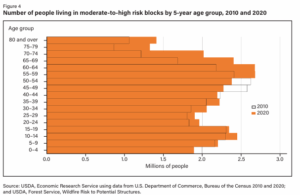
        No relocation: Forsyth & Molinsky (2020) note that to some, aging in place signifies remaining in their home while to others it may mean moving but within the same community, such as downsizing. Based on recent shifts in age distribution in Census blocks with “moderate-to-high” wildfire risk, Winkler & Mockrin (2025) conclude that the increase in older adult populations in fire-prone regions is likely attributable to populations aging in place rather than in-migration (Figure 4). They also note important spatial variation and also uncertainty about the relative contributions of migration and death. They also note that aging in place seems to be the “primary mechanism” in higher risk rural areas (Winkler & Mockrin, 2025). 

        Source: Winkler & Mockrin (2025)

        Health and Health Care : Winkler & Mockrin (2025) summarize the various ways in which older adults can be at higher risk due to wildfires including 1) physical limitations that are barriers to preparation or response, 2) factors like social isolation which can impact access to information and resources, and 3) higher rates of chronic diseases which are risk factors for adverse health outcomes due to fires and smoke. Furthermore, disasters can be disruptive to healthcare, not only by damaging facilities and displacing people from their homes but also by disrupting care which relies on movement. Examples include when patients are unable to travel to hospitals or medical providers, or if healthcare workers can‘t get to a patient’s home due to inaccessible roads (Tarabochia‐Gast et al., 2022) or suspended public transit systems. Rural areas face additional challenges with longer travel times for healthcare access, especially with high levels of hospital closures (Miler et al., 2020; McCarthy et al., 2021). Such patterns negatively impact health care access, emergency medical response, and transport times (GAO, 2021; Kaufman et al., 2016). On average, rural residents must travel about 20 miles farther for typical health care services – in non-disaster times (GAO 2021). While those miles may seem trivial, in emergencies they can mean loss of access to care and treatment. 

        Personal choice: Aging in place can be a personal choice in support of maintaining one’s agency and independence by staying in one’s own home and community (Forsyth & Molinsky, 2020). Even so, staying in one’s home can also result from lack of choice due to limited resources and/or few desirable and affordable options. Modifications are expensive too. Even older adults who are relatively better off can struggle to pay for downsizing or modifying a new dwelling for care needs (Forsyth & Molinsky, 2020).  

        From research to policy 

        To help support healthy aging in place, Winkler & Mockrin (2025) suggest that existing programs that support older adults could be expanded to include wildfire risk reduction. An example is the USDA’s Section 504 Home Repair program which supports older low-income homeowners. In addition, organizations such as the AARP provide useful material for aging in place such as a checklist for people who are prepping their home. Such resources should be expanded to include disaster risk as a consideration.  


        References:  

        • Bukvic, A., Gohlke, J., Borate, A., and Suggs, J. 2018. “Aging in Flood-Prone Coastal Areas: Discerning the Health and Well-Being Risk for Older Residents.” International Journal of Environmental Research and Public Health 15(12):2900. https://doi.org/10.3390/ijerph15122900.   
        • Hauer, Mathew E., Elizabeth Fussell, Valerie Mueller, Maxine Burkett, Maia Call, Kali Abel, Robert McLeman, and David Wrathall. 2020. “Sea-Level Rise and Human Migration.” Nature Reviews Earth & Environment 1(1):28–39. https://doi.org/10.1038/s43017-019-0002-9 
        • Kaufman, B.G., Thomas, S.R., Randolph, R.K., et al. The rising rate of rural hospital closures. The Journal of Rural Health. 2016;32(1):35-43. https://doi.org/10.1111/jrh.12128  
        • McCarthy, S., Moore, D., Smedley, W. A., Crowley, B. M., Stephens, S. W., Griffin, R. L., Tanner, L. C., & Jansen, J. O. (2021). Impact of Rural Hospital Closures on Health-Care Access. Journal of Surgical Research, 258, 170–178. https://doi.org/10.1016/j.jss.2020.08.055 
        • Miller, K.E.M., James, H.J., Holmes, G.M., Van Houtven, C.H. The effect of rural hospital closures on emergency medical service response and transport times. Health Serv Res. 2020;55(2):288-300. https://doi.org/10.1111/1475-6773.13254  
        • Tagtachian, D. and Balk, D., 2023. Uneven vulnerability: characterizing population composition and change in the low elevation coastal zone in the United States with a climate justice lens, 1990–2020. Frontiers in Environmental Science, 11, p.1111856. 
        • Tarabochia‐Gast, A. T., Michanowicz, D. R., & Bernstein, A. S. (2022). Flood Risk to Hospitals on the United States Atlantic and Gulf Coasts From Hurricanes and Sea Level Rise. GeoHealth, 6(10), e2022GH000651. https://doi.org/10.1029/2022GH000651 
        • Winkler, R. L., & Mockrin, M. H. (2025). Aging and wildfire risk to communities (Report No. EIB-284). U.S. Department of Agriculture, Economic Research Service. https://doi.org/10.32747/2025.9015828.ers 


        Continue reading